The Cliffs of Moher in County Clare, on Ireland’s west coast.
You can see the Cliffs of Moher in a day from Dublin. With a private chauffeur, the day starts with a 7am pickup and takes 12 to 13 hours, with stops you choose on the way. Most of the Cliffs trips we drive are for American visitors who want to see the west of Ireland without renting a car or joining a coach tour.
Why a chauffeur suits this trip
The Cliffs of Moher are in County Clare, on the far side of the country from Dublin. That makes for a long day on the road, and with a chauffeur nobody in your group has to drive it. You can rest on the way west, watch the countryside go by, and doze on the way home. The car is yours for the day, so the timings follow your group rather than a coach timetable.
What the day looks like
7am: we collect you from your hotel or home, anywhere in Dublin or the surrounding area.
On the way west: a stop at Bunratty or in the Burren, depending on what you would like to see.
At the cliffs: around an hour and a half to walk the clifftop paths and visit the exhibition.
Doolin, if you like: the village is about 10 minutes from the cliffs, so it is an easy stop before the drive back.
Home: back to your hotel in the evening, 12 to 13 hours after pickup.
Because the trip is private, we talk it through with you before the day and recommend a schedule around what you want to see. Some guests want a castle, some want the Burren’s limestone landscape, and some want as long as possible at the cliffs themselves. Alan, who runs Lir and drives these trips, has a personal passion for Irish history, so ask him about the places you pass. At each stop he drops you at the entrance, and you join the guided tours there, which are booked and paid for at the sites.
Planning your visit to the cliffs
Tickets: our price covers your chauffeur and the car, not entry to the cliffs. The Cliffs of Moher Visitor Experience advises booking tickets online to be sure of entry, and offers lower prices for booking direct.
Opening hours: these change through the year, from 9am to 5pm in winter to 8am to 9pm from May to August, according to the official visitor site. We plan the day around them.
O’Brien’s Tower: entry is included in admission, but the tower can close for weather, so check with staff on the day.
What to wear: the official site calls the weather highly unpredictable and recommends a good rain jacket and walking boots.
When to go: summer gives you the best chance of clear views along the cliffs, but the west coast is worth seeing in any season.
A trip we remember
An American couple on their honeymoon booked several days with us during their stay in Ireland. The Cliffs of Moher was one of their highlights. On another day we drove them around the Ring of Kerry, so between their trips they saw a long stretch of Ireland’s Atlantic coast.
Groups and families
We drive luxury sedans and 7 seater MPVs, so we can take up to seven people in one car. That suits families and small groups who want to travel together and stop whenever they like.
How long is a Cliffs of Moher day trip from Dublin?
With a private chauffeur, plan on 12 to 13 hours. We usually collect you at 7am.
Can we choose where we stop on the way?
Yes. It is your trip, so we talk through what you would like to see and recommend a route. Bunratty and the Burren are popular stops on the way, and Doolin is about 10 minutes from the cliffs.
Is entry to the Cliffs of Moher included?
No. Our price covers the chauffeur and the car. Book your entry tickets directly with the Cliffs of Moher Visitor Experience.
Most overnight flights from the US land in Dublin early in the morning. Once you leave the plane, you go through passport control, collect your bags, pass through customs and walk out into the arrivals hall, where your chauffeur is waiting. This guide walks through each step, and what we are doing while you are still in the air.
Before you fly: send us your flight number
The single most useful thing you can do is send us your flight number when you book. Alan monitors flight times for every airport pickup, so if your flight lands early or late, your chauffeur already knows. You do not need to call or message us from the plane or the baggage hall.
It also helps to tell us how many passengers are travelling, how many bags you have, whether anyone is bringing golf clubs, and where you are going first. That lets us send the right vehicle: a luxury sedan for one or two people, or a 7 seater MPV for families, small groups and anyone with extra luggage.
Step 1: passport control
After you leave the aircraft, follow the signs for passport control. Rules on which lanes and eGates non EU passport holders can use are set by the Irish Immigration Service, so check its website before you travel rather than relying on what you used last time. Queue times vary with how many flights have landed together, which is one more reason to let us track your flight rather than fix a pickup time in advance.
Step 2: baggage reclaim and golf clubs
Collect your bags from the reclaim belt shown on the screens for your flight. If you are travelling with golf clubs or other large items, tell us when you book so the car has room for them.
Step 3: customs and the arrivals hall
Once you have your bags, go through customs and out into the arrivals hall. This is where your chauffeur meets you, at Terminal 1 or Terminal 2. We help with your luggage from the terminal to the car, which waits in the VIP car park a short walk from arrivals, so there is no queue for a taxi and no search for a driver outside.
One recent example: we were booked to collect a senior executive flying in from New York, due to land at 4am. In Alan’s experience, flights from New York tend to come in early, so he kept an eye on the flight tracker through the night. The flight landed an hour early, at 3am, and he was in the arrivals hall when the passenger walked through, then drove them home to Ratoath in Co. Meath.
What we are doing while you are in the air
Lir is based in Ashbourne, a short drive from the terminals, and operates 24/7, so an early landing is not a problem for us. While you are flying, we are tracking your flight, planning the route to your first stop, and timing the drive to the airport around your actual arrival rather than the time on your ticket. On board there is WiFi and water, so you can message home to say you have landed, or simply rest.
Your first morning: hotel, meeting or straight on?
After an overnight flight, most people want one of three things.
Straight to a hotel in Dublin. If your room will not be ready yet, ask your hotel in advance whether it can hold your bags or offer an early check in.
Straight to a meeting. Tell us the address and meeting time when you book, and we plan the pickup and route around it, with time built in for passport control and baggage.
Straight on to the rest of Ireland. Many visitors from the US go directly from Dublin Airport to Adare, Kerry, Galway or the Boyne Valley. We quote the whole journey in advance, with room for luggage and golf clubs, so you can sleep in the car instead of driving on the left after a night flight.
Flying home: leave time for US Preclearance
Flights from Dublin to the US leave from Terminal 2, where you complete US immigration and customs before you board, so you arrive in the US as a domestic passenger. Dublin Airport says Terminal 2 can be busy from 05:00 to 12:00 and advises leaving plenty of time to check in, clear security and complete Preclearance. Give us your flight time and we will plan your pickup with that in mind.
Questions about arriving in Dublin from the US
What happens if my flight lands early?
Alan monitors flight times for every airport pickup, so your chauffeur knows your flight is early and is in the arrivals hall when you come through.
Where will my chauffeur meet me?
In the arrivals hall at Terminal 1 or Terminal 2, depending on where your flight lands. Your chauffeur helps with your luggage and walks you to the car in the VIP car park.
Can I book before I leave the US?
Yes. Email info@lirexecutivechauffeurservice.com or call +353 85 842 0199 with your flight number, number of passengers and destination, and we will reply with a fixed quote. Executive assistants and travel managers can book on your behalf.
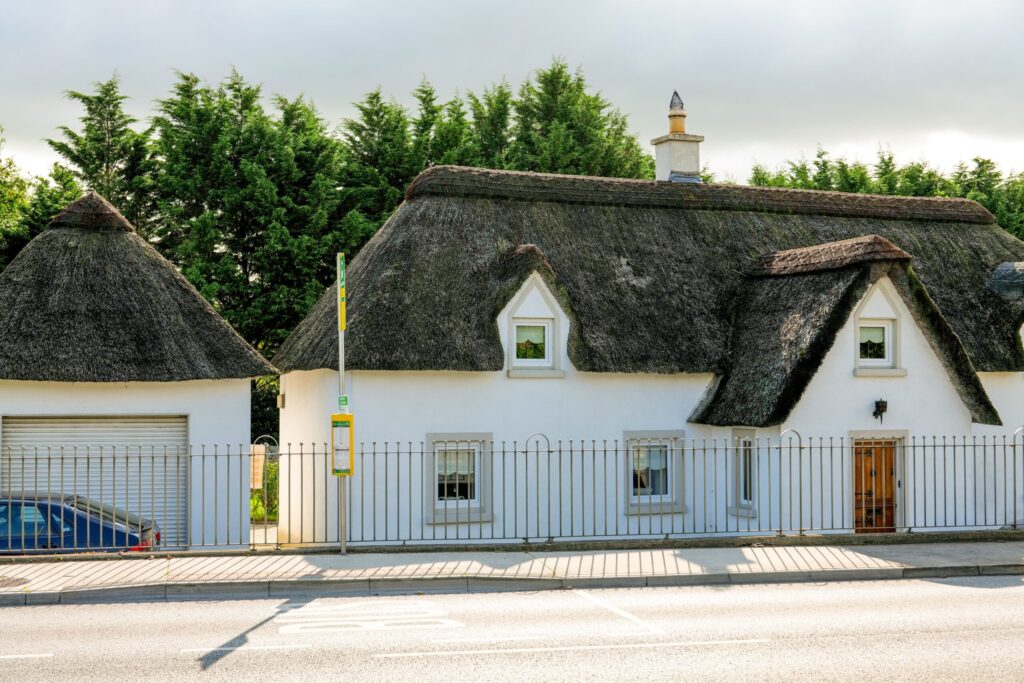
A thatched cottage in Co. Meath, on the drive north from Dublin to the Boyne Valley.
A private chauffeur is the easiest way to see Newgrange and the Boyne Valley from Dublin. Your chauffeur collects you from your hotel or Dublin Airport, drives you the short journey north into Co. Meath, waits while you visit, and plans the day around your tour times, with no coach timetable and no parking to worry about.
Why visit Newgrange and the Boyne Valley?
Newgrange is a passage tomb built over 5,000 years ago, older than Stonehenge and the pyramids of Giza. With Knowth and Dowth it forms Brú na Bóinne, a UNESCO World Heritage Site. The valley around it holds some of the most important places in Irish history, from the seat of the High Kings at Tara to the site of the Battle of the Boyne.
A suggested day trip from Dublin by chauffeur
Morning: collection from your Dublin hotel, then north to the Brú na Bóinne Visitor Centre for the guided tour of Newgrange (tour tickets booked separately).
Midday: lunch in Slane, then the Hill of Slane, where Saint Patrick is said to have lit the Paschal fire.
Afternoon: the Hill of Tara, ancient seat of the High Kings of Ireland, or Trim Castle, the largest Anglo Norman castle in Ireland.
Evening: return to Dublin, or onward to your next hotel.
Every tour is private, so we can change the order, add the Battle of the Boyne site or stop wherever you like.
Why a private chauffeur rather than a coach tour?
A coach tour runs to a fixed timetable for a full bus. With a chauffeur, the day is yours: you leave when you are ready, spend longer where you want, and travel in a quiet, comfortable car. Our 7 seater MPVs suit families and small groups travelling together.
Local knowledge
Lir is based in Ashbourne, Co. Meath, a short drive from the Boyne Valley. Our founder, Alan McLoughlin, has a lifelong passion for Irish history, and the company takes its name from the legend of the Children of Lir. Read more about Lir, or see our private historical tours of Ireland and all our private chauffeur tours.
Frequently asked questions
How far is Newgrange from Dublin?
Newgrange is in Co. Meath, about an hour’s drive north of Dublin city centre, depending on traffic.
Do I need to book Newgrange in advance?
Yes. Newgrange can only be visited on a guided tour from the Brú na Bóinne Visitor Centre and places are limited, so book your tour before you travel. We plan your collection time around it.
Can you collect us from Dublin Airport and go straight to the Boyne Valley?
Every tour is different, so we quote on request based on your route, group size and timing. Your quote covers the car and chauffeur for the day. Entry tickets for Newgrange and other sites are booked separately.
Plan your Ryder Cup 2027 week and your rounds around Ireland with a private chauffeur.
The 2027 Ryder Cup takes place at Adare Manor, Co. Limerick, from 13 to 19 September 2027. There is no spectator parking at the venue, so the smartest way to plan your week is a private chauffeur: Dublin Airport to your hotel, drop offs at your park and ride or rail connection each morning, and golf and sightseeing days either side of the tournament.
How do I get from Dublin Airport to Adare Manor?
Adare is in Co. Limerick, in the south west of Ireland. The drive from Dublin Airport takes around two and a half to three hours by motorway, depending on traffic and stops. A chauffeur meets you in arrivals, handles your luggage and golf clubs, and takes you straight to your hotel, so you can rest after an overnight flight instead of driving on the left for the first time.
Can you drive to the Ryder Cup at Adare Manor?
Not to the gates. The organisers have confirmed there is no parking on site and recommend spectators use the official Park and Ride or Train and Ride services, which need to be booked in advance. See the official Ryder Cup transport page for the latest details.
A chauffeur makes those connections simple. We drop you at your booked park and ride site or at Limerick for the shuttle, and collect you again in the evening, so nobody in your group has to drive or find parking.
Planning your Ryder Cup week by chauffeur
Arrival: collection at Dublin Airport, with your flight monitored, and transfer to your hotel.
Tournament days: daily transfers between your hotel and your park and ride or rail connection.
Before and after: rounds at other famous Irish courses, the Cliffs of Moher, Killarney, or a day in Dublin.
Departure: transfer back to Dublin Airport or Shannon, timed around your flight.
Our 7 seater MPVs suit groups of friends travelling with golf bags, and luxury sedans suit couples and executives.
Why book early?
The Ryder Cup brings tens of thousands of visitors to Ireland in one week, and hotels, cars and drivers in the south west will be booked well in advance. Securing your chauffeur early means your whole week is planned before you fly.
Frequently asked questions
When is the 2027 Ryder Cup?
13 to 19 September 2027, at Adare Manor, Co. Limerick.
Which airport is closest to Adare Manor?
Shannon is the closest airport. Many international visitors fly into Dublin, which has more routes from the United States, and travel on by road.
Can a chauffeur take us to the course itself?
There is no spectator parking or general drop off at the venue, so we take you to your booked park and ride or rail connection. Always check the official transport page for the latest arrangements.
A delayed airport pickup can undo a carefully planned day before the first meeting has even begun. That is why top corporate travel transport Ireland is not really about getting from one address to another. It is about protecting schedules, preserving focus and giving executives a calm, dependable environment in which the working day can continue.
For corporate bookers, the difference is immediate. A standard taxi may be acceptable for a short, low-stakes trip. But when a senior leader is arriving from London for back-to-back meetings, when an investor tour includes multiple sites across the country, or when a client visit needs to reflect the right level of professionalism, transport becomes part of business performance. The vehicle, the chauffeur, the planning and the timing all carry weight.
What defines top corporate travel transport in Ireland
At the top end of corporate ground travel, reliability is only the starting point. The real standard is whether the service feels managed from the moment the booking is made to the moment the passenger steps out at their final stop.
That means pre-booked journeys with clear itineraries, chauffeurs who understand executive expectations, and vehicles that support privacy and comfort rather than simply providing a seat. It also means anticipating practical details, flight monitoring, meet-and-greet at the airport, luggage assistance, route planning and the ability to adapt when a meeting runs over or an additional stop is added.
The strongest providers treat each journey as part of a wider business schedule. They understand that twenty minutes saved at the kerb, a smooth handover at arrivals, or the availability of Wi-Fi in a quiet cabin can materially improve the day. For frequent travellers, these details do not feel luxurious for the sake of it. They feel necessary.
Why executive travellers outgrow taxis and ride-hailing
There is a place for convenience-led transport. But for executive travel, convenience without control is often a false economy.
Ride-hailing platforms can be useful when timing is flexible and service expectations are modest. Corporate travel is rarely either of those things. Vehicle quality varies, drivers may have little understanding of business etiquette, and journey consistency is difficult to guarantee. If a key passenger is left waiting at arrivals or squeezed into a car unsuited to luggage and presentation materials, the problem is not merely inconvenience. It reflects poorly on the business arranging the travel.
A premium chauffeur service offers something more disciplined. The booking is confirmed in advance, the vehicle class is known, and the service is designed around the passenger rather than around app availability. That level of certainty matters to executive assistants, office managers and travel coordinators whose role is to remove friction, not monitor it in real time.
There is, of course, a cost difference. A chauffeur-led service is not the cheapest option on paper. Yet it often proves better value when measured against missed time, disrupted schedules, poor first impressions and the internal effort required to fix avoidable issues.
The operational details that matter most
Corporate travellers notice polish, but they remember execution. The providers that stand out in this space tend to excel in a handful of areas that have a disproportionate impact on the passenger experience.
Punctuality comes first. Not a vague intention to arrive on time, but a system built around timetables, traffic awareness and contingency planning. The best services do not leave timing to chance. They build in the discipline required to support airport transfers, board meetings and tightly sequenced events.
Discretion matters just as much. Many business journeys include sensitive calls, confidential papers or conversations that should never feel exposed. A professional chauffeur understands when to assist, when to remain unobtrusive and how to maintain a calm, private atmosphere throughout the journey.
Vehicle standard is another marker. Executive transport should feel like a continuation of the office or a pause before the next engagement, depending on what the passenger needs. Premium saloons and people carriers offer the space, ride quality and presentation expected at corporate level. Features such as Wi-Fi, bottled water and immaculate interiors are not superficial touches. They support productivity, ease and comfort in ways that business travellers quickly come to value.
Then there is administration. Expense documentation, booking clarity and responsive communication may seem secondary until they fail. For many corporate clients, strong back-office support is part of the service. It reduces post-travel admin and gives bookers confidence that every detail is properly recorded.
Matching the transport to the business trip
Not every corporate journey requires the same arrangement, and this is where weaker providers often fall short. A generic transfer model does not suit the varied reality of business travel across Ireland.
Airport transfers demand precision and a polished first impression. A visiting executive arriving at Dublin Airport after an early start or a delayed flight benefits from a chauffeur who is already tracking the arrival, ready to meet them, assist with luggage and move them quickly into a quiet, comfortable vehicle. The handover should be smooth.
Roadshows and site visits are different. Here, the value lies in route planning, patience and flexibility. Multiple stops, changing schedules and regional travel require more than a one-off pickup. They require a service that can support the whole day without the passenger needing to re-manage logistics between appointments.
Corporate events raise the stakes again. Timing needs to align across attendees, venues and return journeys. The transport should reinforce the professionalism of the event, not become a weak point. For hosts welcoming overseas guests, this is especially important.
Senior leadership travel often demands the highest degree of discretion and consistency. In these cases, chauffeur quality is as important as vehicle quality. Experience, judgement and presentation all count.
How to assess top corporate travel transport Ireland providers
If you are responsible for arranging executive journeys, it helps to look beyond price and availability. The stronger question is whether the provider can uphold your standards under real-world pressure.
Start with their approach to planning. Do they ask the right questions about passenger numbers, luggage, meeting times and contingency needs, or do they simply confirm a collection point and leave the rest implicit? A well-run service is detailed without being cumbersome.
Next, consider fleet suitability. Executive saloons work well for individual travellers or pairs, while larger premium vehicles are often better for teams, airport runs with substantial luggage or roadshows involving presentation materials. The point is not to choose the most expensive vehicle, but the one that fits the duty properly.
Service style should also match the occasion. Some journeys call for low-key professionalism, others for a more overt VIP experience. The best operators can calibrate accordingly. This matters when welcoming international clients, board members or event guests whose expectations may be high from the outset.
Finally, look for signs of consistency. Reviews, repeat corporate use and clear communication all point to a provider that understands the demands of business travel. A premium brand should feel premium not only in its imagery, but in its responsiveness and discipline.
When premium transport makes the biggest difference
There are moments when executive chauffeur travel moves from desirable to essential. High-value client meetings are one. If the day is commercially important, every element should support confidence and composure.
Tight itineraries are another. Where one delay can affect a chain of meetings, site visits or onward travel, a managed service brings reassurance that ordinary transport options cannot match. The same is true for overseas visitors unfamiliar with local routes, traffic conditions or airport logistics.
It also makes a difference when the passenger needs to work. A quiet, spacious cabin allows calls, preparation and decompression in a way that public transport and inconsistent private hire rarely can. For senior professionals, this transforms dead time into usable time.
This is the space in which a concierge-style operator such as Lir Executive Chauffeur Service stands apart. The value lies not simply in the vehicle, but in the sense that someone competent is taking charge of the journey from beginning to end.
The best choice is the one that protects the day
Corporate transport is often judged after the fact. If nobody had to chase a driver, apologise for a delay, rework a schedule or manage a frustrated traveller, the service has done its job well. That is the real benchmark.
Top corporate travel transport in Ireland should offer more than polished cars and courteous manners. It should create order around busy schedules, support executive performance and reflect the standards of the business making the booking. When transport is planned with care, the journey stops being a variable and starts becoming an advantage.
For companies that value time, presentation and control, that is not an indulgence. It is good judgement.
Lir Executive Chauffeur Service
Planning a journey in Ireland?
Fixed quotes, discreet chauffeurs and a car waiting exactly when you need it. Tell us where and when, and we will do the rest.
A delayed pick-up, a missed name board, or a guest left waiting at the wrong entrance can undo weeks of careful planning in minutes. When the visitor is a senior client, board member or international leadership team, how to manage executive guest arrivals becomes far more than a diary exercise. It is a test of preparation, discretion and operational control. For visitors flying in, our executive chauffeur service in Dublin takes care of the meet and greet and every transfer that follows.
For executive assistants, office managers and travel coordinators, the standard is clear. The arrival must feel calm, polished and fully considered, while also protecting the guest’s time. That means looking beyond the flight number and the booking confirmation. The strongest arrival plans account for pressure points before they become visible to the guest.
Why executive arrivals demand a different standard
Executive travel carries a different weight from ordinary passenger transport. A senior guest is often stepping into a full day of meetings, presentations, site visits or negotiations. The quality of the arrival shapes their first impression of the host organisation and sets the tone for the business ahead.
This is why how to manage executive guest arrivals is rarely just about getting someone from the airport to a hotel or office. It is about preserving energy, avoiding uncertainty and creating the conditions for productivity from the moment they land. In practice, that means precision around timing, clear communication, luggage handling, routing and contingency planning.
There is also a reputational layer. If a guest is senior enough to warrant close attention, the way they are received signals how seriously your business takes hospitality and detail. A good arrival looks simple to the traveller, but it takes planning behind the scenes.
Start with the itinerary, not the vehicle
The most common mistake is treating executive arrivals as a simple transfer. In reality, the journey sits inside a wider schedule. Before confirming transport, map the full context of the trip. Know the arrival terminal, expected landing time, baggage requirements, onward destination, meeting start time and whether there are intermediate stops.
It also helps to understand the guest’s preferences. Some executives want a direct, quiet transfer with space to prepare for the day. Others may need to take calls, review documents or adjust plans while en route. If the arrival includes colleagues, family members or security considerations, those details affect vehicle choice and chauffeur briefing.
A premium saloon may be ideal for one senior guest travelling light, but it may not suit a group carrying presentation materials or checked luggage. Equally, a larger vehicle can create a better working environment when privacy, comfort and space matter more than appearances alone. The right choice depends on the traveller’s agenda, not only their job title.
Build an arrival plan around friction points
The smoothest executive arrivals are designed around likely disruptions. Flights land early, immigration queues vary, baggage reclaim slows down and road conditions change. A strong plan anticipates these points rather than reacting to them late.
For airport arrivals, meet-and-greet arrangements matter. The guest should know exactly where they will be met and by whom. The chauffeur should have the traveller’s name, mobile number, flight details and any relevant company information, while the organiser should have a direct contact route in case plans shift. This removes the uncertainty that often causes stress after landing.
Routing deserves the same level of thought. If the guest is heading into a high-value meeting, consider whether traffic at that time of day could put the schedule at risk. In some cases, it is wiser to build in a short buffer and deliver them early to a private lounge, hotel or office reception rather than gamble on a tighter window. Executive travellers notice when time has been protected for them.
Communication should be quiet, clear and controlled
Senior guests do not want to manage their own arrival logistics on the move. They want confidence that everything is in hand. That confidence comes from concise communication before they travel and disciplined updates while they are in transit.
Send only the details they need: pick-up point, chauffeur identification, vehicle description and a direct contact number. Avoid overloading them with unnecessary messages. If there is a material change, such as a revised meeting location or delayed baggage, communicate it simply and with a solution already in place.
Internal communication matters just as much. Reception teams, meeting hosts and personal assistants should know the expected arrival time and any changes. If the guest is going straight into a boardroom or site visit, whoever is receiving them should be ready. Nothing weakens an otherwise polished arrival like a perfectly executed transfer followed by confusion at the door.
The chauffeur’s role is operational and diplomatic
A professional chauffeur does far more than drive. In executive travel, the chauffeur becomes part of the guest experience and part of the organiser’s support structure. Presentation, discretion and situational awareness all matter.
The guest should not have to ask for help with luggage, directions or basic next-step information. Equally, they should never feel crowded. There is a balance to strike between attentiveness and intrusion, and that balance is especially important with senior business travellers.
This is where premium chauffeur services distinguish themselves from standard taxi provision. The vehicle is only one element. What protects the executive’s schedule is a driver who understands timing, protocol, route planning and the value of a composed atmosphere. For many travelling professionals, the car also functions as a second office. Clean presentation, comfortable seating, Wi-Fi and a quiet environment can turn transfer time into useful working time.
How to manage executive guest arrivals for groups
Single-passenger movements are usually simpler. Group arrivals require sharper coordination, particularly for leadership teams, investors or event delegates arriving on separate flights. The challenge is not only transport capacity but consistency of experience.
If several executives are arriving within a narrow timeframe, centralise the information. Keep one live schedule with flight status, passenger names, mobile numbers, luggage notes, destinations and lead contacts. This avoids the common problem of fragmented updates passing between multiple organisers.
There is also a judgement call around whether to consolidate passengers or move them separately. Shared travel may be efficient, but it is not always appropriate. Seniority, confidentiality, differing destinations and varying arrival times all affect the decision. Convenience for the organiser should not override the guest’s comfort or schedule.
For events and roadshows, it helps to assign ownership. One person should oversee the full arrival programme, even if several suppliers or hosts are involved. That single point of control keeps standards consistent and reduces the risk of mixed messages.
Contingencies are part of good planning, not a sign of pessimism
Executive travel rarely goes exactly to plan. Flights are delayed, meetings overrun and venues change at short notice. The difference between average and excellent guest handling is how well those changes are absorbed.
Contingency planning should cover the obvious questions. What happens if the flight lands early? What if the guest’s baggage is delayed? What if a meeting is moved to a different location while they are in the air? If the original vehicle is no longer right because the itinerary changes, how quickly can that be adjusted?
The aim is not to create a dramatic backup plan for every possibility. It is to remove single points of failure. Real reassurance comes from knowing that if the day shifts, the transport arrangement can shift with it. In a market like Dublin, where airport traffic, city-centre congestion and event-day pressures can all affect timing, local operational knowledge adds real value.
Details that shape the guest’s impression
Executive guests remember how an arrival felt. They notice whether they were expected, whether their time was respected and whether the handover from airport to vehicle to destination was calm. These details may seem small, yet they are often what define the experience.
A polished arrival includes a well-presented vehicle, a chauffeur who is punctual and composed, and a route planned with purpose. It may also include simple practical touches such as bottled water, a charging option, or immediate support with luggage and hotel drop-off. None of these features compensate for poor timing, but together they reinforce a high standard.
Expense documentation can also matter more than many providers assume. For business travellers and those managing company accounts, clear post-journey records save time and reduce admin. That is not glamorous, but it is part of what makes a transport partner genuinely useful.
The best arrivals feel easy because they were managed properly
There is no single formula for how to manage executive guest arrivals because every itinerary has different pressures. A board member arriving for one confidential meeting needs a different approach from a leadership team attending a two-day event. What stays constant is the expectation of control, discretion and punctuality.
When the planning is right, the guest is not thinking about the journey at all. They are preparing for the conversation ahead, taking a call in comfort, or simply arriving composed and on time. That is the real benchmark. If you are arranging executive travel, the goal is not just transport. It is to protect the day that follows.
Lir Executive Chauffeur Service
Planning a journey in Ireland?
Fixed quotes, discreet chauffeurs and a car waiting exactly when you need it. Tell us where and when, and we will do the rest.
To provide the best experiences, we use technologies like cookies to store and/or access device information. Consenting to these technologies will allow us to process data such as browsing behaviour or unique IDs on this site. Not consenting or withdrawing consent, may adversely affect certain features and functions.
Functional
Always active
The technical storage or access is strictly necessary for the legitimate purpose of enabling the use of a specific service explicitly requested by the subscriber or user, or for the sole purpose of carrying out the transmission of a communication over an electronic communications network.
Preferences
The technical storage or access is necessary for the legitimate purpose of storing preferences that are not requested by the subscriber or user.
Statistics
The technical storage or access that is used exclusively for statistical purposes.The technical storage or access that is used exclusively for anonymous statistical purposes. Without a subpoena, voluntary compliance on the part of your Internet Service Provider, or additional records from a third party, information stored or retrieved for this purpose alone cannot usually be used to identify you.
Marketing
The technical storage or access is required to create user profiles to send advertising, or to track the user on a website or across several websites for similar marketing purposes.